What does sustainable farming look like here on the Sussex Downs, and how can the principles of agroecology be endorsed and embraced on a regional level?
‘Regenerative’, ‘organic’, ‘restorative’, ‘sustainable’ farming all share a common vision of working with, rather than against nature. Agroecology is the umbrella term which encompasses all these nature friendly farming approaches, as well as a global food and farming movement.
Regenerative farming focuses on the ecological and biological aspects of farming. With the following principles:
- Understand your context
- Minimise soil disturbance
- Plant a diversity of crops
- Protect soils
- Maintain roots all year round
- Integrate livestock
Agroecology also considers the influence of socio-economic, cultural and political factors in food and farming systems.
“Agroecology is concerned with the maintenance of a productive agriculture that sustains yields and optimizes the use of local resources while minimizing the negative environmental and socio-economic impacts.” – Miguel Altieri, Environmental Scientist.
The agroecological movement has gained some traction over recent years, which can be seen at events such as the Oxford Real Farming Conference and Groundswell Regenerative Agriculture Festival; where ecologically minded people have been gathering; as farmers, scientists, researchers, community food organisations, NGO’s and government representatives, to figure out how we can protect the planet in the face of climate emergency.
*Explore the 13 recognised PRINCIPLES OF AGROECOLOGY according to Agroecology Europe.
(In a nice infographic!)
Applying Agroecology to Sussex
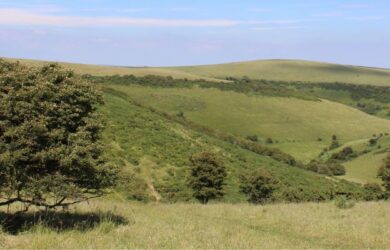
When we look at how regenerative practices might be applied to Sussex (or any region) the geology and soils, topography, and historical landscape character must be considered. Understanding context is key. The majority of the Sussex Downs has shallow lime-rich soils over chalk or limestone. As you move further north and into the Weald, the soil becomes loamy and clayey.

Neither the thin topsoil of the Downs or the sticky clay of the Weald is particularly well suited to horticulture and arable production.
Once you take livestock out of the natural fertilising system, the land calls for other methods of nutrient enrichment. With the post war drive for higher yields of monocrops, this call was answered with the introduction of artificial inputs. Over the years these have decimated wildlife, depleted soils and polluted waters.
Sussex historically farmed sheep and corn; running livestock up on the Chalk Grasslands of the Downs, bringing them down into the deans and valleys in the evenings to fertilise the crops.
Oats, barley and wheat are commonly grown here as well as rapeseed for oil, field beans and peas for livestock fodder. Orchard fruits have always grown well here and of course there is the ever-expanding Sussex wine industry.
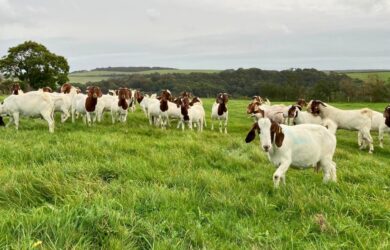
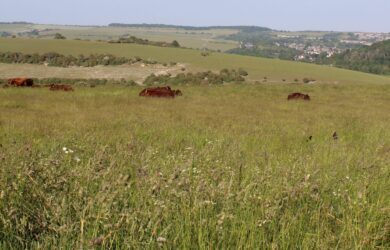
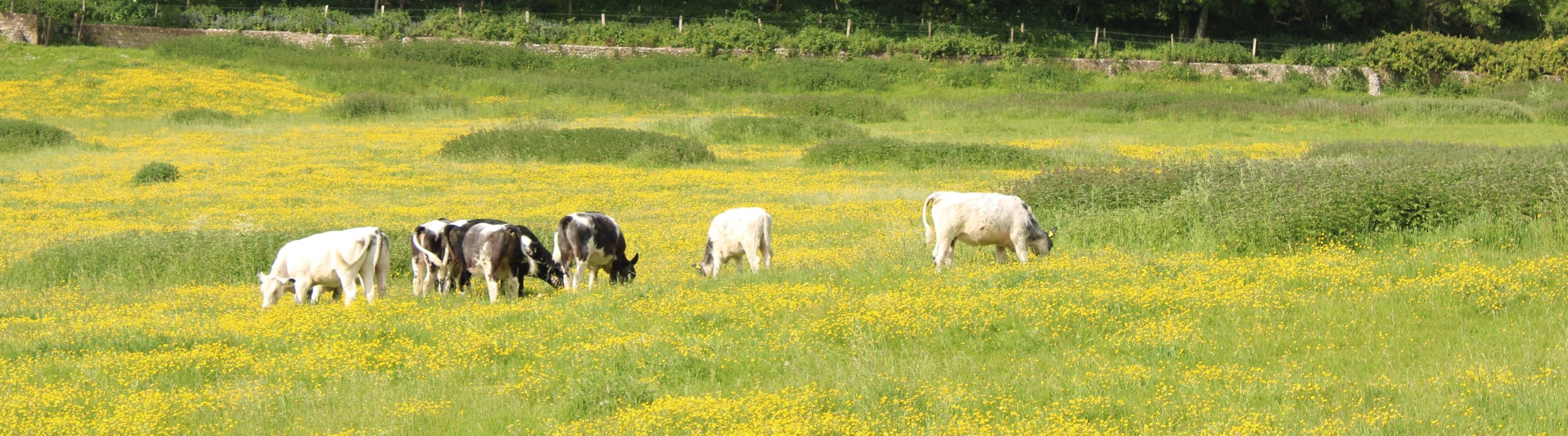
But here, more than anything, we grow grass. Ruminant animals are key to the success of sustainable farming in Sussex; in managing grassland for biodiversity, pushing back invasive weeds and scrub, and fertilizing crops.
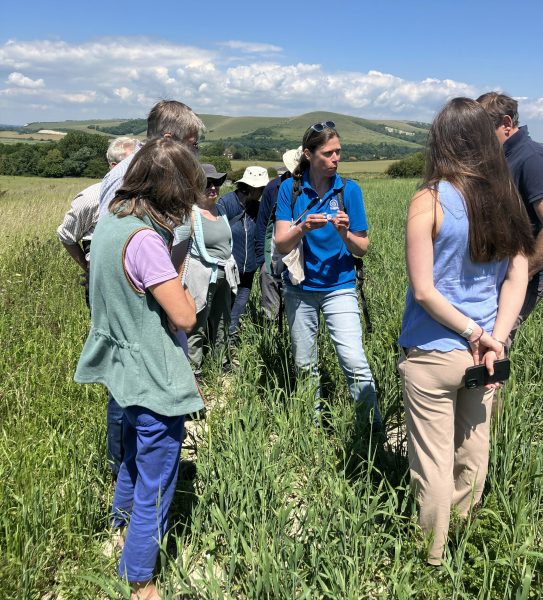
Many local farmers are already lowering their artificial inputs and working in mixed farming systems with a holistic approach; they are sourcing animal feed and fertilizers which is local and natural, reducing use of chemical pesticides and weed killers, keeping soils covered, and allowing for greater biodiversity alongside cultivated crops.
Our local Eastern Downs Farm Cluster group supports farmers in their journey to more nature friendly farming; as you can see from our visit to Cobbe Place Farm in June.
Alice Parfitt of Buglife introduced and identified local species of pollinators, as she took a group of farmers on a bug hunt in the wildflower margin which divided two arable fields.
The Land Use Plus Project endorses the five levels of transitions towards agroecological food systems; this is our take on it:
Level 1 – Increase efficiency of input use and reduce use of costly, scarce or environmentally damaging inputs.
- Influence; more radical local farmers like Duncan Ellis from Long Man, new entrants or new generation farmers like Roly Purzey at Saddlescombe Farm, can lead the way by demonstrating that their system works.
- Farmer led training – learning within the community and sharing success stories.
- A gradual approach to reducing artificial inputs in one area and experiment with natural alternatives, with less financial risk.
- Carefully considering the most appropriate crop or animal for the land.
LEVEL 2 – Substitute conventional inputs and practices with agroecological alternatives
- Farming subsidies from UK Government DEFRA are there to support a transition to sustainable farming. It’s a pick and mix approach for a tailor-made solution on farm. These still need some work, but are heading in the right direction.
- Grow nitrogen fixing crops which support our nutrient poor soils.
- Plant cover crops to protect the soils rather than leaving them fallow.
- Find the best way to integrate livestock in arable production to reduce artificial fertilisers
- Sow regionally appropriate herbal leys / wildflower and grass mixes for increased biodiversity.
LEVEL 3 – Redesign agroecosystems
- Create rotational systems, beneficial to both cash crop and flock.
- Longer term farm planning – not just looking at the farming year but a 10-20 year plan.
- Calculate farm emissions not only on livestock emissions but also taking into account the whole farm, machinery use, road miles, and foreign imports of inputs.
- Calculating carbon capture from cover crops and other environmentally positive interventions.
- Localise input production: hay, straw, fodder, manure. Can this be purchased from a neighbouring farm or within the county?
LEVEL 4 – Reconnect consumers and producers through the development of alternative food networks
- New routes to market – independent shops, meat boxes schemes & farmers markets.
- Networking of supportive organisations, local councils, and public bodies.
- Develop new procurement practices for schools, hospitals, care homes and prisons with local and sustainable foods.
- Subsidised sustainable food for those on lower incomes.
LEVEL 5 – Build a new global food system based on participation, localness, fairness and justice
- Work with individuals to make a change locally whilst playing into a regional, national and global network of game changers. Disrupting the supermarket stronghold and fighting for fair trade and food security.
For more information visit:
Nature Friendly Farming Network