
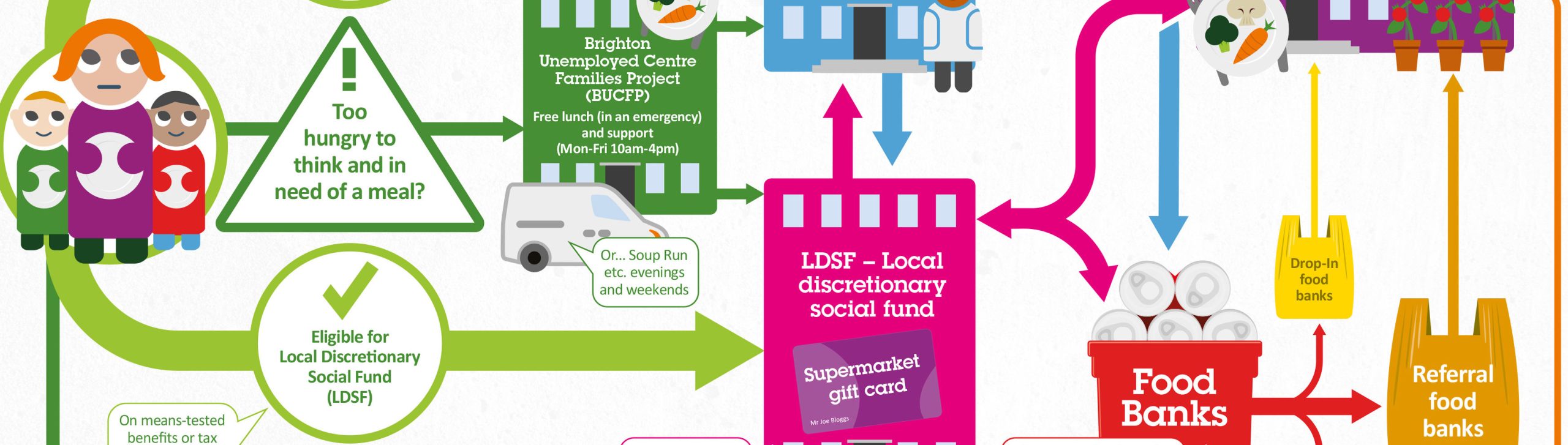
The Brighton & Hove Food Poverty Action Plan took a city-wide partnership approach to tackling food poverty, in a climate where there was reduced funding against a backdrop of increasing need.
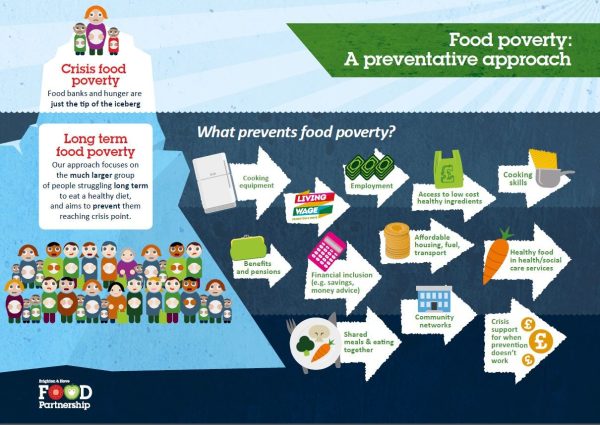 The plan aimed to reduce levels of both long term food poverty (“household food insecurity”) and of crisis or ‘emergency’ food poverty including food bank use. There was a focus on tackling the underlying causes of food poverty – not just picking up the pieces. There was an aspiration to promote shared eating and on ‘becoming the city that cooks and eats together.’ Over 78 actions, each with an agreed lead partner, worked towards these goals.
The plan was coordinated by the Brighton & Hove Food Partnership and was developed in 2015 (see case study). This work sits within the city-wide food strategy.
Over 50 cross sector partners are signatories to the plan and agreed to adopt 10 principles underpinning this approach to food poverty work including focusing scarce resources on those most at risk, and seeking to measure levels of food poverty in order to better understand it and track progress. Key stakeholders include:
- Brighton & Hove City Council (partners in over half of the actions)
- Other statutory sector organisations
- Community, voluntary & faith groups
- Food banks – via the Emergency Food Network
- Shared meals settings
- Advice services
If you or someone you know is experiencing food poverty please see our advice pages.