Check out our Community Composting 101 video for a brief overview of the processing for our schemes:
Who was involved in setting up the first community composting schemes?
The idea for a community composting scheme came from a group of garden volunteers who were active in one of the city’s garden schemes, which we helped to co-ordinate. They had the idea of having a community wooden box for composting. Together with this group of activist-volunteers, we helped pitch the idea to the Growing Great Ideas Fund, which funded projects that demonstrated an ‘ability to seed and grow alternative systems’. The initial idea was successful and received funding for one year, and worked as a collaboration between the Council, residents, and the Food Partnership. We have carried on with this model ever since.
How is the project funded?
After the initial one-year funding from the Growing Great Ideas Fund, the project came to be funded by Brighton & Hove City Council. Within the one year of grant funding, we managed to set up ten schemes, in doing so proving that we were committed and competent, meaning that the Council were willing to continue to fund us. This carried on for a further ten years which helped us to set up many more schemes. We currently have 56 sites across the City. At present our Council like many others, are facing financial difficulties and have been required to pair back our funding. We’re grateful for their continuing support which enables us to keep the project going, though new schemes need to seek alternative funding sources to cover the set up costs for the equipment, carpentry & materials.
Why community composting and not home composting in gardens?
Community Composting makes sense given the context of Brighton & Hove – we are a densely populated city, with spatial constraints on housing due to the proximity of the South Downs on the northern edge of the city and the sea to the south. As a result of this, we have more people living in flats than in any other city outside of London. Community composting was envisaged as way to give people living in housing without gardens the opportunity to compost their food waste.
Currently, one compost bin (out of a set up of three) can accommodate approximatly 30 households or roughly 340L of food waste a week which would otherwise be sent to landfill. This waste is instead repurposed into compost for use by residents and the leftovers for local community organisations. Our Community Composting FAQ covers many questions and concerns we have fielded about our schemes.
Our composting schemes are much more popular in areas with a high density of flats – where there are gardens, we encourage people to partake in home composting instead. Check out our composting at home tips here.
How is the scheme co-ordinated?
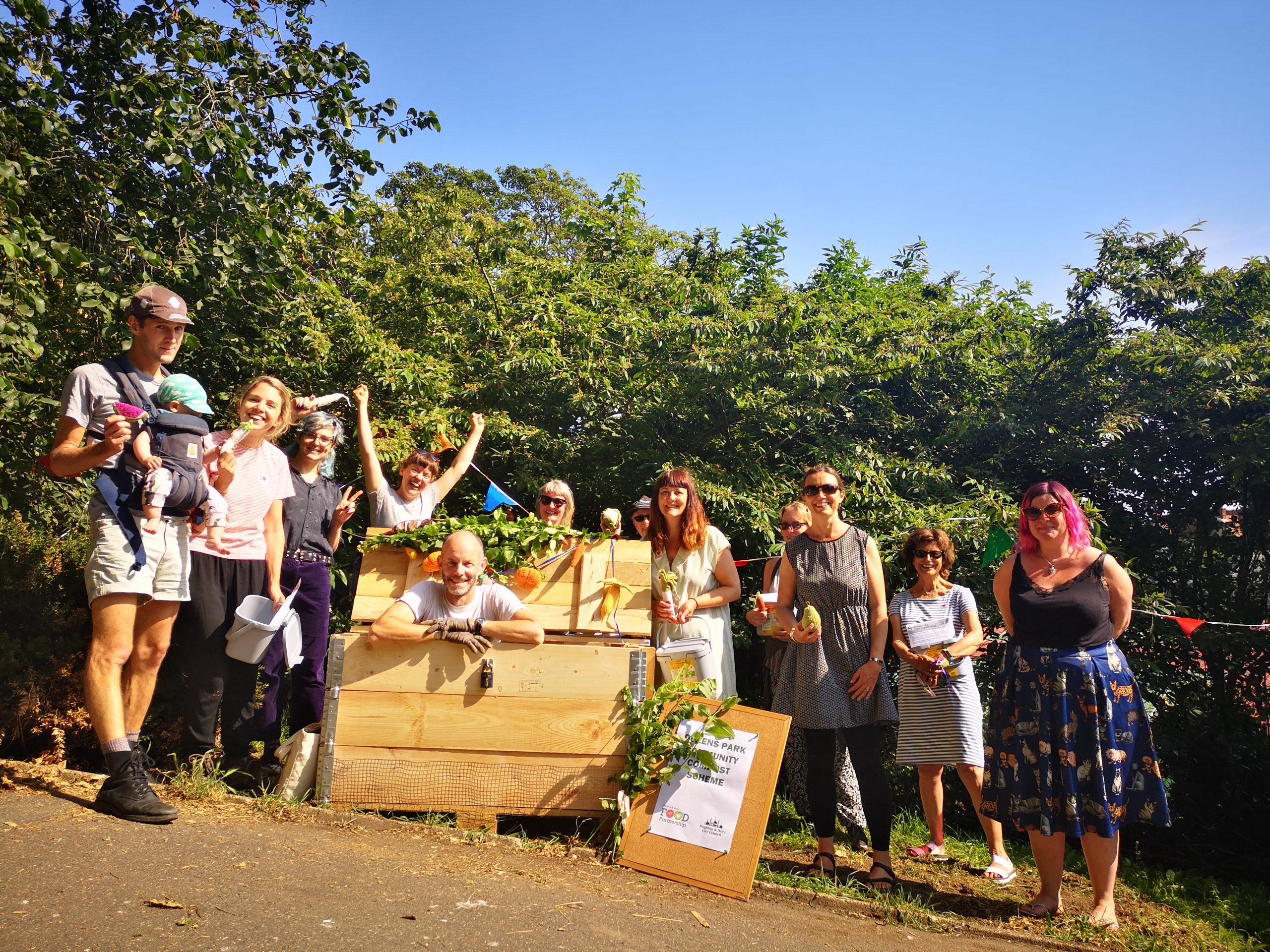
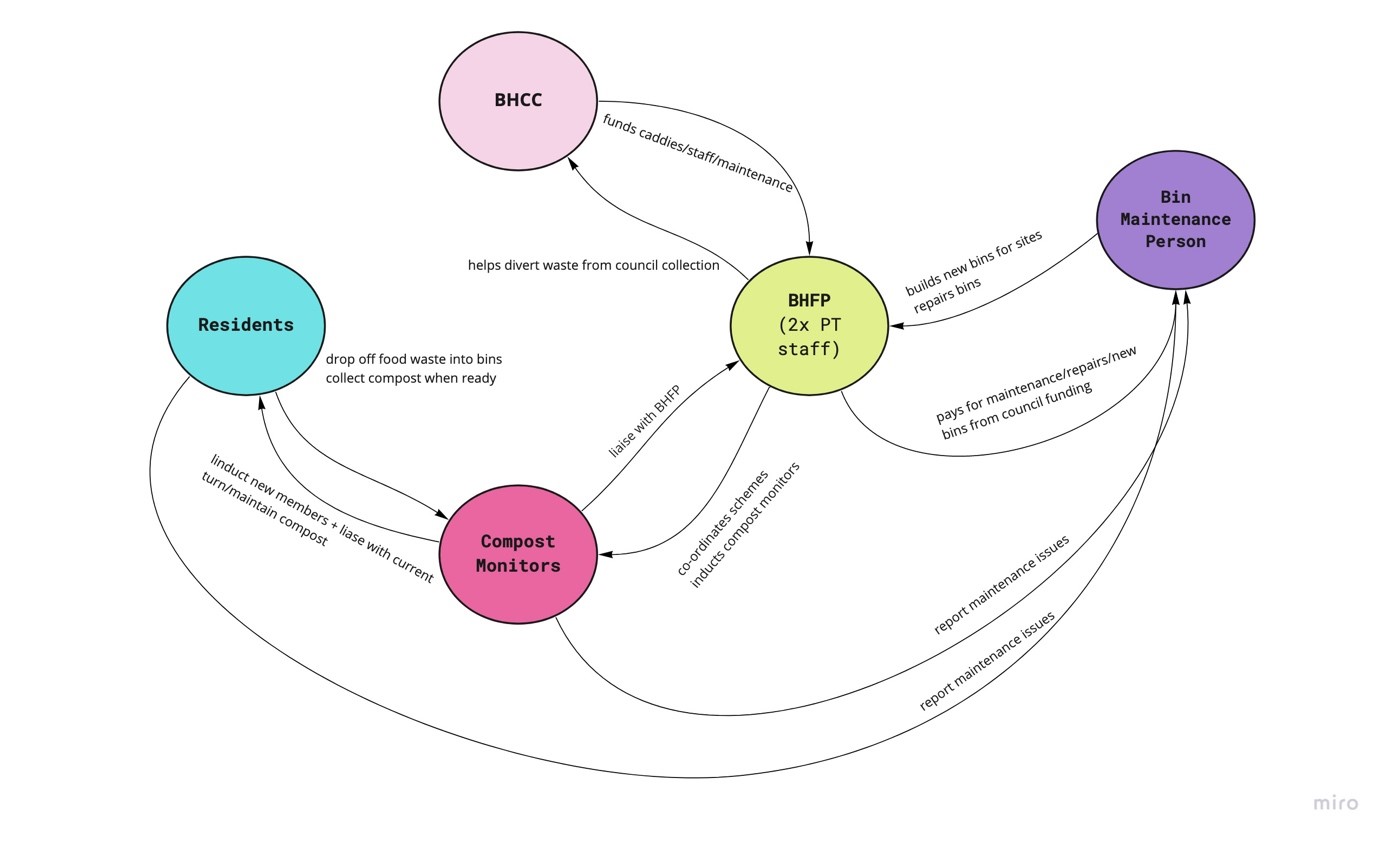
The scheme works as a partnership between the Brighton & Hove Food Partnership, the Council, residents, and volunteers.
The Council provides the Food Partnership with funding to manage the scheme, which we use to pay for the compost caddies, to fund a paid member of staff to manage the scheme, and to pay an external maintenance person who repairs bins for us and builds new ones.
We (the Food Partnership) play a co-ordinating role, having oversight of the 50+ schemes across the city. This involves keeping updated contact lists of all the members for each scheme, acting as the central point of contact for people wishing to join, arranging the maintenance of the boxes, helping community groups through the process of setting up new schemes and doing the necessary liaisons with the Council and local residents.
Each scheme has two volunteer compost monitors, who are responsible for overseeing their local scheme. Compost monitors induct new members to their scheme and update the waiting list, turn the compost, report repair requests, and liaise with the Food Partnership about any issues they are having.
Residents are those who are members of the compost scheme. Signing up is free, but there is often a waiting list as our schemes are nearly all oversubscribed. Residents will drop off their food waste at the bins and turn the compost, as well as take responsibility for keeping the area tidy.
How do you communicate across the scheme?
We try and streamline communications as much as possible between our staff, monitors and residents. Members or monitors can fill out an online form that goes straight to our bin maintenance person if they need to report an issue with their bins. There is also another online form for residents residents to fill out if they would like to become a member of a scheme too, so that their details go straight into a waiting list spreadsheet.
Compost monitors have a contact list for everyone on their scheme, which they can use to inform people on the scheme if compost is ready for collection or if there are any issues with the bins. This is a spreadsheet owned by BHFP to comply with GDPR and accessed by monitors.
What are the steps you take when setting up a scheme?
Find out more about how we setup a new community compost scheme.
How much do bins cost?
A single bin costs about £320 to make and install, whilst a whole package for a new site costs around £1105 including all materials and equipment. With staff time, the price is closer to £1,400
What alternative methods are there to community composting?
There are different models of composting schemes that exist across the region that are also worth checking out. A well-established model, for example, is the Compost Club scheme that runs across Brighton, Lewes, and mid-Sussex.
Why community composting?
Our schemes help build resilient communities whilst reducing our city’s carbon footprint, which is why we would love to see more community composting schemes locally and nationally. Our video below gives a brief introduction into how to set up and maintain community schemes, and below we explain why we love them.
Need further advice, or a presentation for a council board or community group?
Consultancy rates are available – get in touch at compost@bhfood.bozboz.dev or on 01273 234810.
Our citywide community composting scheme helps over 1200 households across Brighton & Hove recycle their food waste.