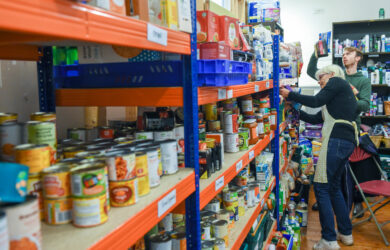

In 2025 we visited Whitehawk Foodbank to speak to their team as part of the Emergency Food Network report. It was clear from this conversation that their work surpassed emergency food provision. The organisation’s trusted presence of over 10 years in this community has allowed them to provide expert advice, practical support and a warm welcome, with far reaching impacts. They have taken the issues at the root of food insecurity to MPs at Westminster, lobbying alongside local foodbank clients themselves for an end to the need for food banks and to Guarantee our Essentials.
It is undeniable that there is unfortunately still a need for emergency food support in Whitehawk, and across the UK. The cost of living has pushed more than 5,800 households across Brighton and Hove to need food help per week. The Whitehawk Foodbank are now facing significant challenges and are running a crowdfunder, read more about their work in 2025 below, and please consider donating.
Interview carried out in Summer 2025.
As part of the Trussell network, the Whitehawk Foodbank strives to achieve the organisation’s wider strategy of ending the need for food banks in the UK. Operating out of St. Cuthman’s Church on the Whitehawk estate in East Brighton, they have sought to embed local advice services alongside emergency food provision (accessible via referral) to help clients find ways out of food-bank reliance.
Whilst they are looking to move beyond the foodbank model, Foodbank Manager Saz Fury told us “actually just closing the doors of our Foodbank wouldn’t help our community. There’s a whole lot of what we call ‘upstream work’ that needs to be done to help someone be ready to move on.”
This is where the Advice Café comes in. Available to everyone within the community (not just foodbank users) the project offers holistic support, including budgeting and housing advice, counselling, and pet care. The open church hall where the food bank is based provides the setting for visiting local service providers to offer face-to-face advice.
This is especially important in an area where services are located a lengthy bus ride away, as outlined by Daisy, the Neighbourhood Engagement Coordinator, ‘’it’s so helpful when you can go ‘Oh, you need help with that? There’s someone on the table just there who can talk to you about that exact thing. We’ve made this as accessible as possible, so people who might struggle to seek out advice in town have it quite literally on their doorstep’’.
Of course, there is no guarantee that those who may benefit from the service will actually take the opportunity on their first visit. As a third staff member we spoke to pointed out, “what we’ve identified working and being in the Whitehawk community is you have to do things slowly. You have to build relationships first. You cannot do things for people, it really has to be with the community and alongside them’’.
This is where the Foodbank’s volunteer ‘befrienders’ play a crucial role. They do more than simply go around and take people’s dietary preferences, they provide a welcoming space and can have quiet conversations where clients feel comfortable to open up.
From having one-to-one support sessions with clients, liaising with local Neighbourhood Associations, establishing pilot schemes like Wednesday Night Dinners, to engaging with community members whilst on their way to the local supermarket, the foodbank staff and volunteers are working tirelessly to build trust and bridge relationships across the estate.
These efforts go beyond trying to understand client’s needs and pitch their services, it also links to their national campaign efforts. In July this year, as part of Trussell’s ‘Guarantee our Essentials’ Campaign, Daisy’s team including a client from the Whitehawk community went up to Westminster for a lobby day to demand that Universal Credit (UC) cover people’s basic needs.
This is a pressing issue for a community where levels of deprivation and incapacity benefits claims remain high, and was made more urgent by proposed cuts to Personal Independence Payment (PIP). The day at Westminster was a powerful experience and, according to staff, had a lasting impact on both themselves and the community at-large.
“Being able to take her and show her this is what goes on and that actually you’re just as much a part of this as any of these people in suits are. I just love to think of the knock-on effect that will have, that people from this area realise that it’s for them as much as it is for anyone else; if anything, that they’re the voices that are really needed. To take the exact things they’ve said to me and take it to Parliament, where things are changed, its so magical”.
Reliance on foodbanks as places of emergency food provision can’t solve the root causes of poverty. But their role as sites of community bonding, knowledge sharing and relationship building can bring people together to mobilise for change, with the potential for lasting impacts across the country
“Being part of the change is really exciting, to be able to offer a level of stability and a listening ear, and to have a brilliant team of volunteers who know how to do all that stuff. Yeah, its a real honour for sure.”
Contact whitehawk foodbank
Email: info@thewhitehawk.foodbank.org.uk
Website: thewhitehawk.foodbank.org.uk