As requested by the Emergency Food Network, we are launching a bulk buying pilot project. Local food projects are invited to express their interest and get involved.
The aims of the project are to:
- secure competitive prices for local food projects via bulk buying.
- reduce the Emergency Food Network’s annual collective spending of £700,000 a year.
- work collectively to reduce the admin time which individual food projects spend on procurement.
This pilot project is aimed at any Emergency Food Network members who already spend money on non-perishable/ambient food.
How will it work?
For the initial pilot, we are ordering two pallets of ambient food from the Food and Community Trust (FCT), an organisation founded by Sheffield’s S6 Food Bank designed to support projects delivering emergency food.
- Food projects can visit our ordering platform, where they can purchase from a small range of popular items
- To make sure we sell all our items we’ve divided the half-pallets we’ve bought of each item into “blocks”. You can buy these items in blocks, you are welcome to buy multiple blocks
- To fulfil the minimum order we need each project to order 6 blocks, but that can be of any item
How does collection work?
- Once you have made your order, we need you to watch a manual handling video to ensure you can safely collect your items. Email us to let us know your order is in, and to confirm you’ve watched the safety briefing.
- We will send you a list of collection slots within a timeframe of one month.
- Collection is from FareShare Unit 8, you can reverse into the unit.
- Everyone is responsible for taking what they’ve paid for, and not more. There will be trays available for you to use to load your items.
Why we decided to do it this way
- You can see how we calculated prices against best local prices for the same items, and there is a clear saving for projects. Mapped across a year, we’ve projected that a large project could save £2,288 a year, and a medium project £1,144 a year.
- This is a pilot, so we hope to extend the range of items in the future. We aim to do a second pilot before deciding whether to roll this out.
- We chose a small range of items that gave the best savings because buying in this quantity is expensive, so it was less risk to buy a smaller range.
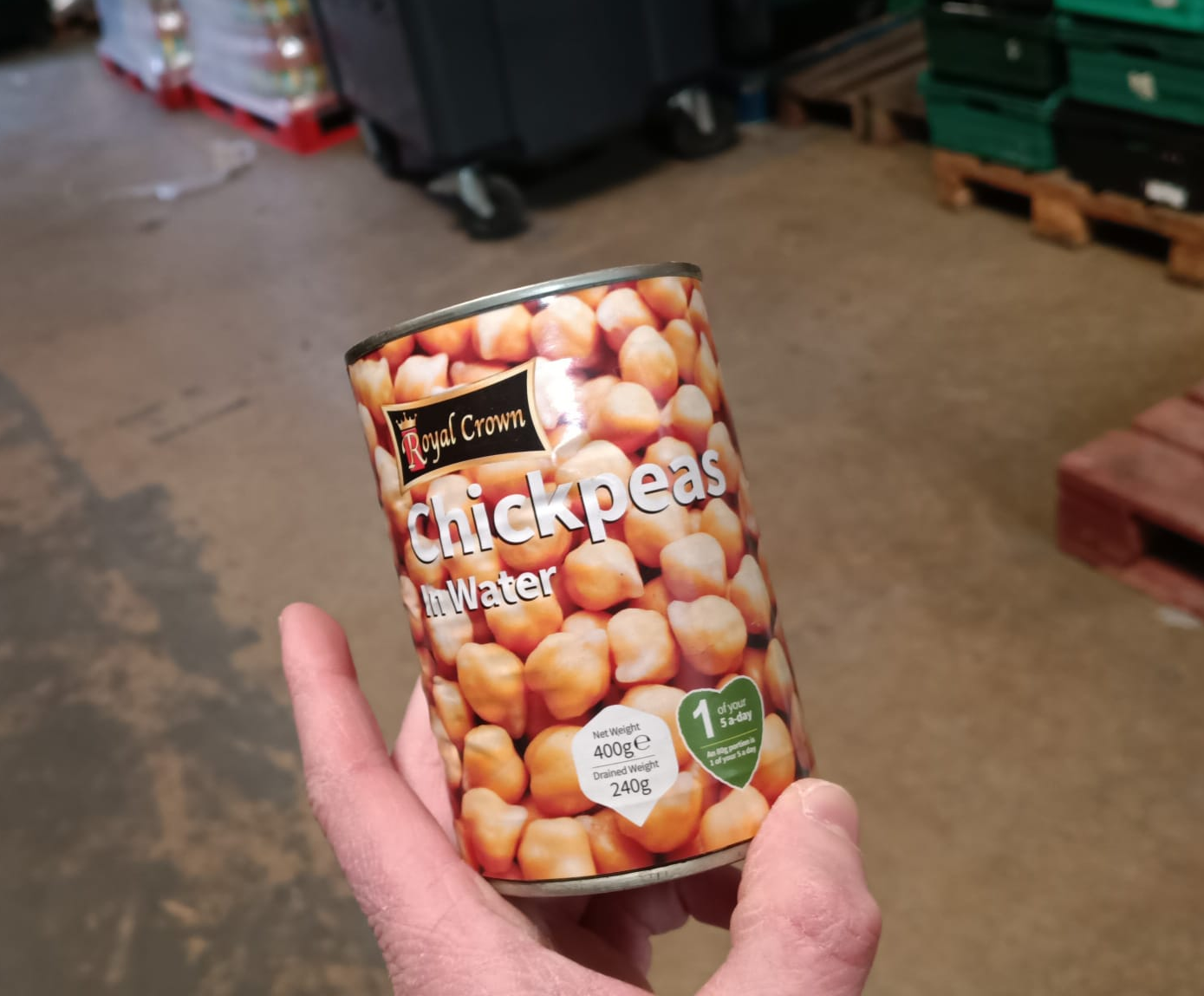
- We’ve divided each half pallet into blocks of units (e.g. half a pallet of chickpeas is 1152 cans, we’ve divided that into 12 so that you can buy chickpeas in a block of 96 cans). Each pallet type will have different block sizes depending on how many items is in the half pallet.
- We’ve added £100 for FareShare to store and handle the items, and £50 towards admin costs per delivery, to keep it sustainable.