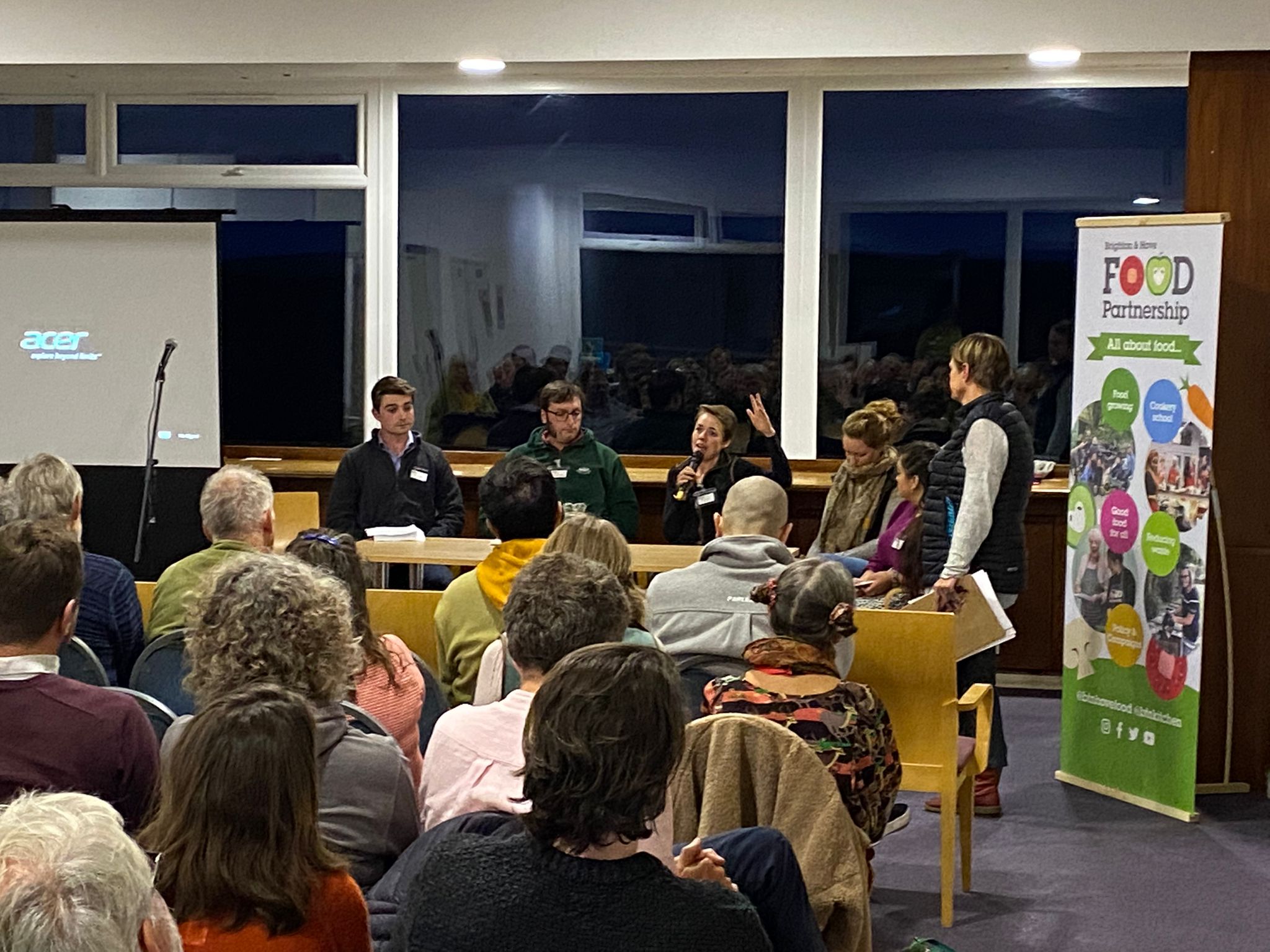
We were delighted to launch our Land Use Plus Project formally at the end of October with a conference aiming to answer the sizable question of “what are the challenges and opportunities for local farmers, food producers and retailers in terms of nature friendly farming and local food supply?”. Thank you to those who attended for all your feedback, you’ve certainly given us plenty of food for thought. To those of you who couldn’t make it, please read on. We’ve broken down the findings of the day and pulled some actions from them.
The breakdown
It was important to the Food Partnership that we heard from supporters of the Land Use Plus project, as our aim is to facilitate communication between bodies working to support spaces for nature and people, whilst also pushing for sustainable food production. The evening began with a talk from Tim Rowkins, chair of the City Environment, South Downs and the Sea Committee who discussed the City Downland Estate Plan and the need for connectivity. I followed this with an introduction of our Land Use Plus programme which calls for sustainable, local food production and a joined-up approach towards land use. We then heard from Melanie David-Durand and Martin Harris from the UNESCO Living Coast Biosphere regarding its role in protecting the environment, biodiversity and water, while supporting sustainable economic development and local food systems.
A panel discussion led by Vic Borrill, our Director, featured Francesca Cooper and Hollie Fallick of Nunwell Home Farm, Harrison Anton from C-L-M and the Eastern Downs Farming Cluster, alongside James Woodward, the project lead for BHCC’s City Downland Estate Plan. This discussion highlighted the potential of Brighton & Hove as a market for local food producers due to its size, general affluence, and proximity to producers. However questions from the delegates made it clear that a lack of infrastructure and clarity of need are currently barriers to developing this. It was also clear that certain foods, such as wheat, may not easily feed into a local food system.
We then broke into four working groups, with delegates joining a discussion of barriers and opportunities around whichever they felt they had the most to input on. Here are the notes from each section.
Working group feedback
1. Processing
Opportunities
- Infrastructure mapping – Look at the work that has already been done by Sustain and the Greater Brighton Economic Board.
- Mobile abattoir – Is this a viable option, what is the appetite for this? Can it be ruled out based on cost and lack of facilities/ capacity?
- Tablehurst DIY model – Further consultation opportunities.
- What facilities do local agricultural colleges have to support small farmers – does the wine department have a bottling plant that that might be useful for other local producers e.g. for Trenchmore cider? Butchery facilities, are they used during the holidays?
- High Weald Dairy have a consistent supply of good quality local milk to produce their cheese. They also have a fully functioning wholesale channel with The Cheese Man – Who have a fleet vans. There isn’t always a problem with local infrastructure – look at the people who are making it work.
- Consider social enterprises or businesses making local products from waste e.g. Spirit of the Downs.
Barriers
- Wholesalers – under-represented at the event but an important and hidden part of the puzzle. More research needed to establish who they are.
- Working with chefs/restaurants very hard and inconsistent (on both sides – supply and demand)
- Lack of abattoir and vets.
- Milk vending is prohibitively expensive.
- Farmers can’t always afford to take the risk to step into local/ direct sales.
- Lack of kitchens / affordable space
- Small scale butchery isn’t very profitable – earning cap for butchers
- Lack of cold storage at the local abattoir and on the local farms for those who would like to direct sell.
Suggested next steps
- Look at farm clusters or coop opportunities
- Local hubs connecting to a regional hub
- Tap into existing hubs and wholesale networks
- More mapping of processing facilities. What is available where and what is missing.
2. Logistics
Opportunities
- Community Supported Agriculture (creates a consistent demand/market)
- Social / community investors for logistics company / cooperative
- Logistics = boring but marketing = crucial for a more exciting and interesting result
Barriers
- Local meat going into global supply chains – can our local farms produce 10% for local consumption?
- Consistency of demand – farmers/producers need to know their products can sell
- Difficulty of transporting food from difficult terrain / multi-purpose vehicles
- Making it profitable for farmers AND affordable for locals
Suggested next Steps
- Develop a forum / working group(s) to get the ball rolling
- Develop a strategy with a timeline and end goals
- Create a “Sussex Grown” brand
- Get seed funding for a business model to handle the logistics
- Get councils or private sector to invest in the infrastructure
- Get a financially sustainable model to get meat from the Downs to local consumers
3. Finance
Opportunities
- Philanthropic investment – Platforms like Ethex can offer ways for people who want more local food to invest
- Can Southern Water help?
- There is a % of customers who will pay premium for ethical products. Even if this was only 10% of Brighton & Hove, it’s a lot of customers
- Farmers would like to sell more to local markets (they all said it) but most don’t want to set up direct selling or weren’t sure where to start
- Links to customers – who can help with this (FP / Sussex Grazed)
- Interest in less but better meat – also interest in different meats e.g. Goat
- Opportunities for Farm to Customer but also Farm to local business – who is exploring this?
Barriers
- Unattractive for investors – e.g. 5+ years to get a return on investment
- How to scale up from selling a handful of animals each time to bigger scale – (Suggests FP meeting farmers to look at this question e.g. what would it take to sell 50 animals a year directly)
- Concern amongst farmers that if more than one of them sells to local market they are competing for a very small market – discussion about point that idea is to extend the market not compete – how to enable consistency of price from multiple farmers?
- A lot of what is currently produced is grain / barley but local market for that not there (although interesting discussion about Long Man brewery)
- Concern that the cost to customers is too high and people won’t pay (household budgets squeezed)
- Meat the main product suitable currently (but more people are plant based)
- Abattoir capacity
- Challenge re horticulture in SDNP not just investment but planning permission
4. The Consumer
Opportunities
- Consumer demand – Sussex and, in particular B&H, a perfect marketplace for local food
- Strong food culture in Sussex – Good selection of restaurants to connect with
- Provenance / connection – Lots of farmland close to urban populations – history of food production
- Brighton Festival – Should have locally sourced food on the bill
- Allotments / Market gardens on each tenant farm (where land allows)
- Estate Agents – Advice and support readily available for farmers
- Pop-up seasonal local markets – Celebrating local produce as part of tourism (currently not advertised as a food destination – links with Biosphere).
- Large population on doorstep – Across Sussex
- Public sector procurement, schools, universities, colleges, hospitals, care homes – tough nut to crack but could provide regular orders and make local food more accessible
Barriers
- Availability – not enough produce grown locally
- Apathy / Lack of trust / knowledge of benefits of buying local
- Lack of info about local products and where to buy
- Councils are challenging to collaborate with
- Time constraints to deliver your produce to restaurants
- Missing networks and infrastructure to deliver farm to fork
- Lack of variety / scale
- Strong vegan / anti-meat / climate agenda
- Tourism doesn’t fit the local food narrative
- Don’t have a local food identity / brand
Suggested next Steps
- Bring the South of England Farming Show into the centre of Brighton or the Downs.
- Farmer / producer open days
- Local food brand/recognition – Biosphere
- Food hub/processing facility
What are we doing next?
We are delighted that the conference created space to allow us to see and hear about the wide range of issues in the sustainable and local food sector, as well as highlighting the many similarities.
It is clear to us that there is a real desire for connection, both in terms of communication and the missing infrastructure links between producer and consumer. If a local, sustainable food network is to be created, this must be addressed. Through Land Use Plus, B&H Food Partnership can offer staff time which can be used to research barriers and opportunities for scaling, facilitate conversations and connect those working on similar projects.
From the information we gathered at the event, we are moving forwards with three key areas of work:
- Infrastructure
- Abattoir – it is clear that a long term, local, solution is required if more meat is to make it into the local market
- Food hub – a better understanding of the wholesale sector is required, but a food hub which aggregates multiple sources could help make large scale local procurement easier.
- Increase sales of “icon” products locally: A commitment to increasing the percentage of locally grown foods in the local market. Linking with the food hub work, but also revisiting a Sussex “brand” of sorts. This could link with the Living Coast Biosphere work.
- Mobile grazing: A continuation of the work within the BHCC estate to ensure difficult pockets of land are grazed, and bring these animals into the local food system.
We will be creating (or have already created) working groups to ensure breadth of knowledge for each of these areas of work. If you would like to be involved in any way, please get in touch.
Last but not least
like to say a huge thank you to the amazing local food and drink producers who made the evening really special. We had local cheese from High Weald Dairy, lovely hummus and nibbles from Smorls, reclaimed soup and rolls from Sussex Surplus, sausage rolls from Brighton Sausage Co, and tasty bakes from Flour Pot Bakery. There was fresh pressed and mulled apple juice from Brighton Permaculture Trust, wonderful kombucha from Old Tree Brewery, Skylark Coffee kept us all awake and (in a happy surprise for all) Spirit of the Downs popped up with some samples.
A full list of delegates and their contact information can be found here.