Isy from the Food Partnership met with Charlotte, the founder of Therapy Kitchen, over zoom to find out what her project is all about. Therapy Kitchen is a transformational service where cooking meets therapy. By cooking together, Charlotte encourages people to explore complex feelings and situations and reconnect with themselves and their communities.
Charlotte explained that Therapy Kitchen came about when she was working as a psychotherapist whilst also hosting cooking classes at a local college. It was in these cooking classes that she discovered the parallels between how people were approaching cooking to how they were approaching life. Charlotte explains that Therapy Kitchen is a holistic approach to cooking and in turn, addressing deeper feelings and situations.
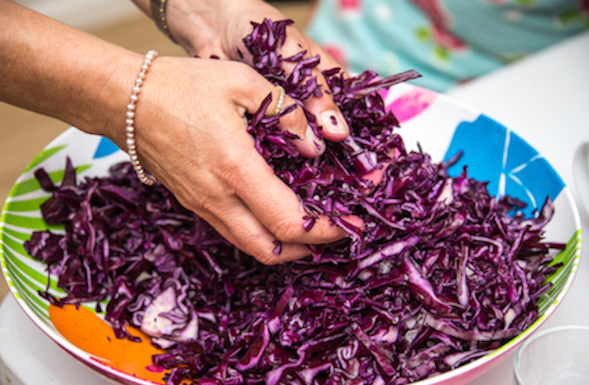
Therapy Kitchen has worked in collaboration with multiple community projects. One such project that Therapy Kitchen has worked with is Chomp which supports families and children who are experiencing challenges such as food poverty and holiday hunger. Therapy Kitchen’s collaboration with Chomp involved cooking sessions with parents to boost confidence and skills in the kitchen.
When discussing the difference between traditional talking therapy and therapy kitchen, Charlotte said.
“Often, just talking about our feelings can be incredibly abstract. Sometimes it doesn’t make any sense to approach our feelings by discussing them and it can end up being really alienating. It can be hard to label how we feel about things but by using metaphors in the kitchen, we can see the similarities between cooking or food with bigger and more complex feelings. Using a physical tangible object to describe feelings can be so powerful.”
Even something as simple as how you use a wooden spoon during cooking can represent how you approach your everyday life; these parallels can be made throughout the kitchen and can offer a more accessible way of evaluating feelings.
As with all things in life, the journey of Therapy Kitchen has been a learning experience, Charlotte describes the most important lesson she learned.
“It’s okay to make mistakes and being accepting of the process is part of life. To be a good cook and good at life we have to accept mistakes and be comfortable with uncertainty. We need to drop our perfectionist ideologies. It’s okay to just have a go, even if things don’t work out as planned or as the recipe said – the true enjoyment and learning comes from the process. Just because a mistake has been made, it doesn’t mean you need to give up.”

Charlotte explores the power of letting go of the perfectionist attitudes that we all hold. “If we really enjoy doing something then often the product ends up being really great. It doesn’t matter if it doesn’t look like ‘how it’s meant to’, and we need to overcome our fear of failure.” This sense of letting our guards down and just having a go is reflected in the results of her work.
Charlotte works with different levels of skills and confidence and flexibly meets their needs. “Building confidence is the essence of my work”. Charlotte’s focus on empowerment within the kitchen directly translates to encouraging confidence within people’s lives.
Her passion for Therapy Kitchen speaks volumes, to the work she does. “I am so lucky to work within a role that I feel so at home in. I enjoy bringing together the things I love: storytelling, people and food.”
It was a wonderful opportunity to meet Charlotte and I know I will never look at a wooden spoon the same again!
To find out more about Therapy Kitchen, please visit: https://therapykitchen.co.uk/
To book a session: https://therapykitchen.co.uk/services/kitchen-therapy.html