
In this special blog for the COVID-19 Day of Reflection 2025, Brighton & Hove Food Partnership (BHFP) Director Vic shares her personal memories of the pandemic food response. She reflects on this difficult time in solidarity with the unsung heroes who helped out back then, and the many who are still helping out today. Vic’s stories inspire gratitude, frustration, encouragement, and some might just make you smile.
When asked to write about the food response provided by the voluntary and community sector in Brighton & Hove during the Covid-19 pandemic as part of the National Day of Reflection, I am drawn back to remembering how it started.
An already planned Emergency Food Network meeting on 17th March 2020, 1 week before the first national lock down. We’d moved the venue to a large room, opened some windows and sat in a big circle. Maybe 20 people from different food banks, community cafes, surplus food and meal projects were there.
The vibe in the room was sombre. The news coming in from Italy was alarming. Projects told us they were struggling to buy food as supermarkets had introduced 2 item limits, shelves were emptying, people using food banks were too afraid to come out and some groups were shutting down.
I can recall the feeling in the room – we knew that together we were going to need to step up and do something. We could never have imagined what that ‘something’ would turn into.
The central purchasing and neighbourhood food hub concept sketched out at that meeting formed the basis of the work for the next 3.5 years, summarised in this case study.
We also agreed that we would start straight away and work out how to pay for it as we went along!
Community and Voluntary Sector response
The community and voluntary sector (CVS) mobilised – responding faster than local and national government, faster than food businesses. This has since been referred to as ‘moving at the speed of trust’ a phrase that still resonates with me.
Within a week we were taking phone and email referrals for people needing food. My colleague Kate Donoghue ran this operation for 2 months from her makeshift office in a garden shed until the Brighton & Hove City Council Community Hub line opened. Kate is just one of many unsung heroes from this time.
We did a call out for venues to become food hubs and got a citywide spread made up of current food projects, faith settings, community centres and other CVS groups. They recruited volunteers to deliver food to their communities and BHFP set up a central operation to bulk buy food to redistribute out to them. This approach meant that whilst the buying and sorting operation was at scale, the ‘last mile’ delivery to someone’s door was by a person they might recognise or could relate to.
This became a huge operation. Data from the week of 18th May 2020 shows in one week these 50 food hubs provided food parcels and meals to 7000 people with 548 people volunteering 3,270 hours of time.
Reflecting on what to write about this extraordinary time I come to four themes – gratitude, encouragement, frustration and absurdity.
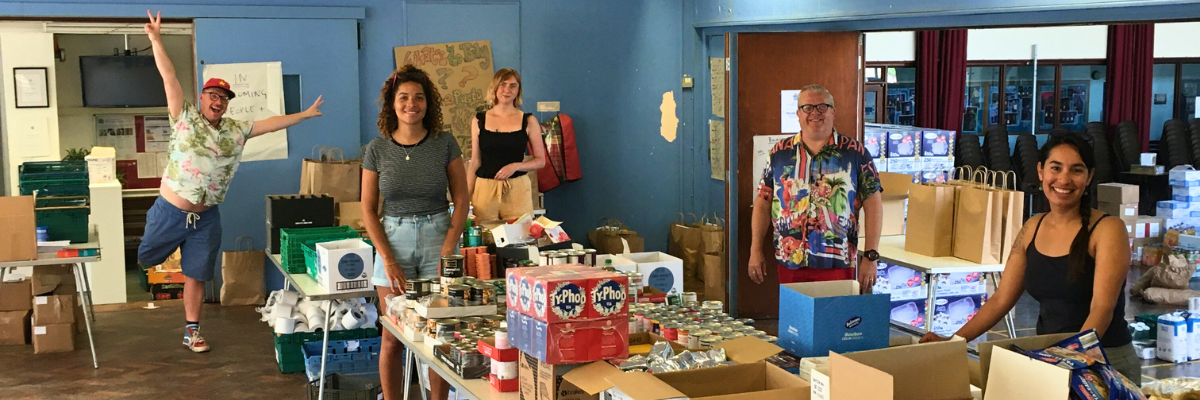
Gratitude – for those that volunteered, gave money or resources
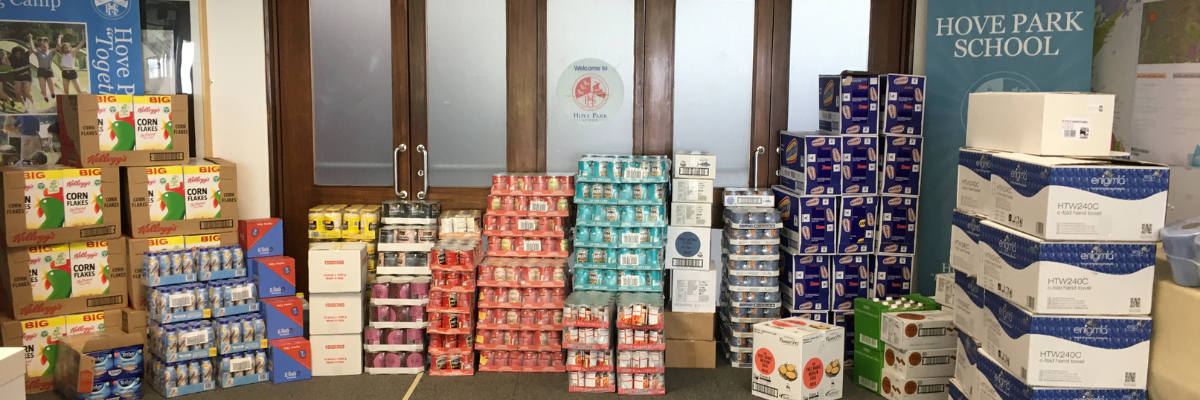
BHFP opened a central food sorting hub at Hove Park School. Our redeployed Community Kitchen manager Jo Glazebrook ran the space – performing an incredible job balancing logistics, risk management and compassion. Our hub volunteers came from all walks of life – people whose day jobs had stopped – airline staff, chefs, bar-staff, actors, the caretakers at Hove Park School who opened their school hall doors for us each day.
Others who stepped in included the local businesses that used their vehicles to deliver for us – vans from Zedify, Brighton CityMet College and Loud Shirt Brewery. Local pubs and restaurants donated their stock, the school meals service loaned us fridges and freezers.
The BHFP central hub, onward delivery of food and parcels, and the 50 local food hubs all relied on volunteers. All involved were dealing with their own Covid-19 stories – family and friends ill and dying, living with their own fears and frustrations. But those receiving the food parcels commented time and time again that what they received was more than food – it was kindness and connection. The volunteer was for many the only person they saw face to face, in some cases the only person they spoke to that day.
When we started, we had no money. Surplus food wasn’t going to be enough and whilst we got venues for free, we needed cash to buy food and other essentials. Our first Crowdfunder set out to raise £15K. In the end we raised an incredible sum of over £100K from public donations and were also supported by Lottery grants and local and national government funding.
In those early days smashing our first crowdfunding target, reaching £30K within a few weeks, gave us much needed cash but also faith that the city’s residents had our backs and supported what we were doing, even when their own lives were so uncertain.
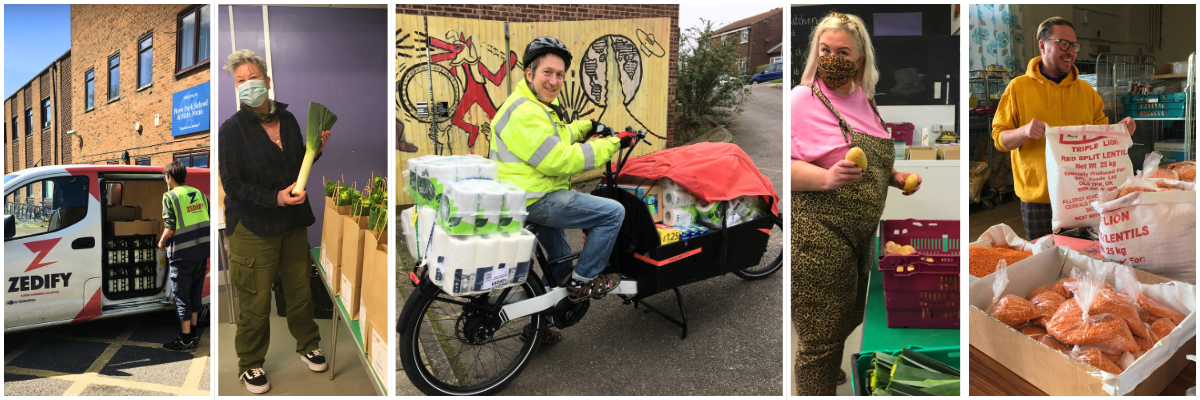
Encouraged – by what we can do together
The hub locations knew their own communities best, so could adapt their offer to meet the needs of the people they were delivering to in a way that a top-down offer couldn’t. That could be types of food for cultural diets, activity packs for children or quizzes aimed at keeping older people living alone entertained. The volunteers were able to help with other tasks for shielding people, like posting a letter or picking up a prescription. As time went on the volunteers got to know the likes and dislikes of the people they were delivering to – little things like putting ‘marmalade not jam’ in the bag for Mr Stephens.
We found new ways to get food. Working via the Food Factory, we bought local produce such as milk, veg and eggs off local farmers that had lost custom with the closure of schools and hospitality, providing them a vital income.
The relationship with Brighton & Hove City Council (BHCC) was instrumental to the success and showed local government and community sector partnership working at its best.
Via the BHCC ‘food cell’, led by the unflappable Emma McDermott, my weekly and sometimes daily chats with her covered an array of things the food hubs told us they needed. Food safety advice, public health updates as rules changed, sourcing masks and anti-bac, cleaning materials, updates on supermarket opening times, where to get help for alcohol dependent people, information about the free school meal provision, ways of accessing money for self-isolating people, options to use BHCC contracts to bulk buy food…. the list went on.
A summary written at the time shows how many people from so many teams at the local authority contributed in so many ways.
Frustrated – at so much still left to be done
Over time many hubs shut, returning to their former identity – befriending organisation, faith setting, youth club or community centre.
But my reflection brings home how we aren’t taking what we learnt from the COVID-19 pandemic into current health policy. The need for food support in Brighton & Hove hasn’t gone away.
Prior to the pandemic, there were 420 households a week being supported with food parcels. Currently there are 6,300 people each week relying on food support from food banks, meal projects and affordable food shops/pantries.
This is because the Covid-19 pandemic was followed by the Cost-of-Living Crisis and because too many people do not have enough income to cover their basic living costs.
BHFP runs the Emergency Food Network, whose members operate out of 60 locations. This includes food projects that existed before the pandemic, groups that started during the pandemic and evolved into new models. One example is Phoenix Food Hub, set up in 2020 with support from BHFP and still run by and for the local community to this day.
Most are now places people go to collect food in person. But there is still a need for a delivered meal / food service for the most vulnerable, especially those coming out of hospital. Our NHS funded report into the needs of people living with long term health conditions and disabilities and the work of East Brighton Food Co-op shows that this need is left unmet for many vulnerable people.
Why is no-one properly considering re-introducing community delivered Meals-on-Wheels as a statutory service as a policy in the current NHS reforms? Good meals to the most vulnerable will help prevent hospital backlogs, they speed up discharge and help prevent re-admissions. It is an affordable community health intervention that focuses on prevention, and has been proven to work under the most testing of circumstances.
What is so frustrating is how institutionalised the crisis response has become. Food support is not just being used for a short term or emergency need and more. 58% of those being supported are doing so on an ongoing basis. This is alarming given the increasing evidence that long-term reliance on emergency food support can result in mental trauma and diet-related reduced life expectancy.
And years of involvement can also take a toll on the volunteers and project co-ordinators. Everyone wants long-term, structural solutions to the problem of poverty so hungry people don’t keep coming to their doors. No one that stepped up in 2020 to help expected to be needed for this long.

Absurdity – some things I can’t quite believe really happened!
- The redeployment of Brighton & Hove Regulatory Services ‘dog van’ to pick up wholesale food – the memory of watching tins of fruit, veg and meat balls being unloaded from the cages usually used for stray dogs still makes me smile.
- The phone call – “Do you want 5,000 eggs?” “Yes sure, drop them at this address.” I didn’t realise they meant Easter Eggs destined for now cancelled National Trust Garden Easter Egg hunts. We were the proud owners of a huge Easter Egg Mountain (they all got given out!).
- The day the road where the usual delivery vans were parked was completely blocked by a crane. A call out was sent for anyone from the volunteer team with a vehicle. Our delivery fleet that day was a VW campervan, a gold soft-top sports car, a couple of estate cars and a Fiat Punto. One volunteer offered to help so long as where she was delivering to was flat because her handbrake didn’t really work!
- The central government organised food parcels delivered to people shielding that just kept coming. No matter how many times people who no longer needed them tried to stop them, they arrived on doorsteps week after week. The contents were often absurd – catering size tin with kilos of mushy peas anyone? Volunteers were deployed to pick them up to pass on to groups that could use them.
- “There is no zoom at the inn” – Hosting an online hub-volunteer’s Xmas party complete with a scripted nativity play … maybe I did dream that one!
Thank you and solidarity
If your Covid-19 day of reflection involves thinking back to how you volunteered to help or how you donated skills, money or stuff – thank you.
For those of you still involved in the Emergency Food Network – thank you for all you have done over the last 5 years.
To EFN Project Co-ordinators, if your day of reflections ends in the feeling of ‘enough’ or if you ever need to stop for your own wellbeing – please reach out to us at BHFP. We can try to help you have a break or transition the project.
And please keep connecting to each other. The pandemic food response proved how strong we are when we work together.
Impacted by these stories or want to share your own reflection
If you or someone you know needs support, you can find a range of organisations and resources on the Help and Support page on the Day of Reflection website.
Reach out to us on social media, or via email at info@bhfood.org.uk