
The agroecological movement – is it just a bunch of hippies?
While the agroecological movement can look like a bunch of hippies on the surface, it is rooted in science, history and culture, and led by real farmers. You’ve probably heard of it in one of its many forms: nature friendly, regenerative or permaculture farming, using practices including organic, biodynamic, or no dig. No-one can quite agree on the terminology, but there is a clear and ever-growing movement for change. This movement shows that farming isn’t the problem, but rather could provide an answer to the climate (and economic) crisis that the world is now faced with. The right kind of farming happening in the right place needs investment, scientific research and public support. More than anything, though, it needs to be championed by a government who understands the potential of environmentally focused farming.

Agriculture and Climate Preparedness
The extreme weather at the beginning of January really couldn’t have been more appropriate for demonstrating one of the key drivers of agroecological farming; a need to act against climate change and to prepare for its impacts. Huge swathes of the UK’s prime agricultural land, as well as much of the centre of Oxford, was underwater. We tend to think of farming as taking place between spring and autumn, but many crops (and animals) are grown and even thrive throughout winter, meaning that farmers are seeing huge losses from the widespread flooding we’ve already experienced this year. Agriculture holds huge potential to answer the climate crisis. As the industry which produces 15% of UK, and 30% of global greenhouse emissions, relatively small changes to the way in which we farm can have great impacts. Healthy soil, meadows and trees also sequester larger quantities of carbon than intensively farmed fields and are better able to hold water, protecting against both drought and flood.
Food Citizens – The power is in your hands
Food Citizens (that’s us!) hold huge power. The conference encourages us all to use our voice, pens and paper, to support campaigns that lobby the government to invest in more environmentally sustainable solutions to feeding the country (and the world), to hold supermarkets to account for unfair treatment of food producing farmers and to stop false labelling practices.
It’s a big responsibility, but is also up to us as food citizens to regularly ask the questions ‘how did my food get here?’ and ‘what are the environmental and social implications of my food choices?’ A complicated and hidden food system has, until now, taken away a lot of our choices and allowed farmers to be undercut, human and animal health to be impacted, and supermarkets to profit. One of the things you can do to fight against this destructive capitalism is to find a short food supply chain; learn about food grown in your area and how it gets from farm to fork. Simply put, find a local shop that supports local farmers. Small changes can make a big difference; think about what can be produced sustainably where you live and start there. Here in Sussex, apples and pears, lamb, beef, fish and eggs are good options.
Grazing for good
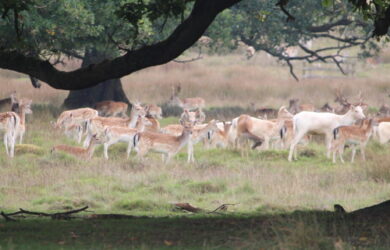
Whilst it is not the popular media narrative, grazing animals like cattle and sheep can be good for the planet. In the UK, we have lost 97% of our (incredibly biodiverse) meadows since the Second World War; a direct result of agricultural intensification. Agroecological, regenerative, organic (and the like) farmers need more financial backing and continued scientific investigation into the benefits of sustainably managed grazing for carbon sequestration and biodiversity to challenge the narrative that livestock farming has a terrible environmental impact. There is still a lack of scientific studies on livestock producing greenhouse gases and the measures don’t consider the nutritional density of the meat produced or the way in which the livestock were farmed within a whole farm system. The public can support considerate farmers by eating less but better sourced local meat. It is encouraging that the government are beginning to back considerate farmers by a greatly increased farm subsidies for conservation grazing land for biodiversity.

A Lack of Local Infrastructure
Small scale farming is under threat. In Sussex, perhaps the most pertinent and alarming issue is closures in the local abattoir sector, which may soon devastate the local meat industry in the UK. This would leave the national or international market (which, by their very nature, have far greater negative environmental impacts) as the only remaining option. Or lab grown meat. Improvements to local infrastructure across all farming sectors would allow smaller farmers to be able to feed local populations, alongside the national market.
Working from a local perspective is key to developing transparent, fair food systems. Land type and quality differs greatly across the UK, so we need the right farms in the right places producing food with the fewest inputs and best environmental return. For this to work, we also need the right infrastructure to bring this locally produced food to local people.
Three Key Points
Overall, the conference showed us three key areas for action:
- Look after the soil: Over 70% of land in the UK is agricultural. If this soil is well cared for and healthy, it has huge potential for carbon sequestration and improved water absorption.
- Work with nature, not against it: minimise intensive farming systems and chemical inputs, put the power back into small farmers hands.
- The system, not just the individual, needs to support small scale agroecological solutions to the climate and biodiversity crises we are currently experiencing.
Our Land Use Plus project is supporting a switch towards agroecological farming across the City Downland Estate. Along with Sussex Grazed, the project is also working to develop robust local supply chains to bring locally produced food into the city.